May 13, 2026
The $20,000 Hammer: How the July 1st Parent PLUS Caps Will Change Your College Budget
By Peter Young, Founder of My School List
During my twenty-three years in education leadership as an elementary and middle school principal, I learned that the families who do best are usually not the ones with the biggest budget. They are the ones who see the blindspots early enough to make a plan. That is exactly why I want to get this in front of you now.
Right now, a massive shift is coming for parents of high schoolers. If you live in the DMV area and have a junior or a senior, you need to put down your coffee and look at the calendar.
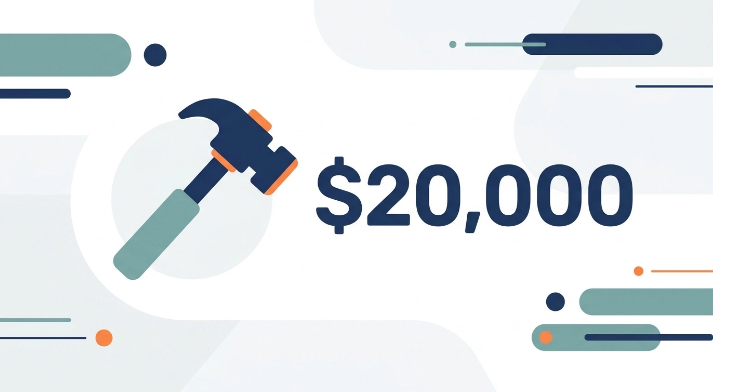
On July 1, 2026, the federal government is dropping a hammer on the way families pay for college. For decades, the Parent PLUS loan program was essentially an open faucet. If your child got into an expensive school, you could borrow the full cost of attendance. Those days are ending.
Public Law No. 119-21, also known as the One Big Beautiful Bill Act or OBBBA, is about to change your financial life (Department of Education). Whether you are a parent in Bethesda, Arlington, or D.C., the rules of the game are shifting mid-stream.
The "Unlimited" Era is Over
For years, Parent PLUS loans were the fallback plan for families who didn't have $80,000 a year sitting in a 529 account. You could borrow up to the total cost of attendance minus other aid. There was no aggregate limit.
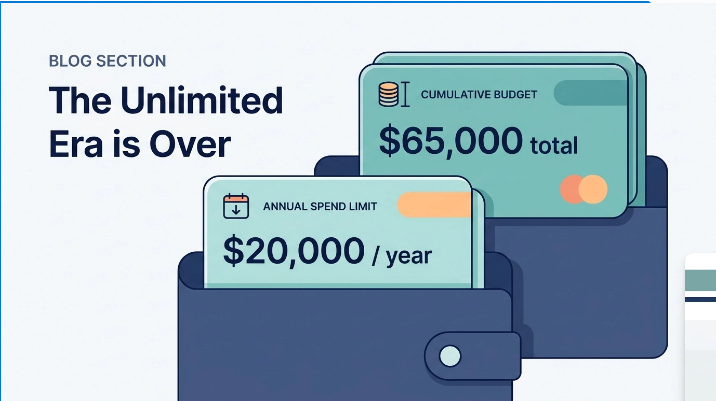
Starting July 1, 2026, the OBBBA introduces two major caps that will change your college search strategy. First, there is now an annual cap of $20,000 per student per academic year (NASFAA). That limit is per student, not per parent. If two parents borrow for one child, they still share the same $20,000 total for that student. If your child is heading to a school with a $60,000 gap after scholarships, you can no longer bridge that entire gap with federal parent loans.
Second, there is a new lifetime borrowing limit of $65,000 per student (Public Law No. 119-21). Again, that cap is tied to the student, not to each individual parent. This is the part that catches most families off guard. If you borrow the maximum $20,000 for the first three years, you will hit your lifetime limit before your child even starts their senior year.
The Math Trap: $20k x 4 is not $65k
Let's look at the math because it is the most important part of this entire policy. If you are planning to use Parent PLUS loans to cover a significant portion of a four-year degree, you are walking into a trap.
If you borrow $20,000 for freshman year, $20,000 for sophomore year, and $20,000 for junior year, you have used $60,000 of your $65,000 lifetime limit. When senior year arrives, you only have $5,000 left in the federal tank.
For parents in high-cost areas like Northern Virginia or Montgomery County, where many students aim for top-tier private universities or out-of-state flagships, this $65,000 limit is a very low ceiling. You cannot simply "loan your way" through an expensive degree anymore.
The Repayment Sting
It isn't just about how much you can borrow. It is also about how you have to pay it back. Previously, parents had access to various income-driven repayment plans that could make the monthly burden manageable based on their earnings.
For loans originated after July 1, 2026, those options are vanishing. New borrowers will be funneled into a tiered standard repayment plan that lasts between 10 and 25 years (Department of Education).
Perhaps the most painful change for our local DMV workforce is the impact on Public Service Loan Forgiveness or PSLF. Many parents in our area work for federal agencies, non-profits, or local governments. PSLF is not gone, but for most parents who borrow under the new rules, the path is gone in any practical sense. New Parent PLUS loans after July 1, 2026 are limited to the new Standard Repayment Plan, and only the 10-year version of that plan qualifies for PSLF, which will not apply to most borrowers given the new loan balances (Public Law No. 119-21; Department of Education). For DMV federal workers, non-profit employees, and others counting on PSLF, this is a meaningful change.
Who is affected: Class of 2026 vs. 2027
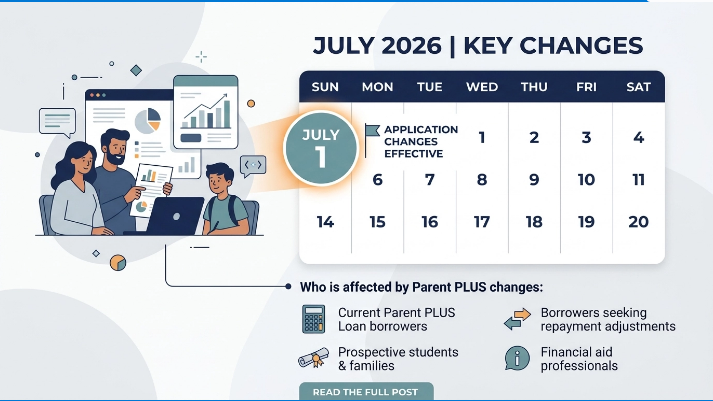
If you have a senior in the Class of 2026 who is heading to college this August, you have a small window of protection. The law includes a legacy rule for parents who borrow before the July 1 deadline.
If you take out your first Parent PLUS loan for a student before July 1, 2026, you qualify for a legacy provision that allows you to continue borrowing under the previous rules for three years or until your student completes their current program, whichever comes first. The student also has to remain continuously enrolled in the same program at the same school (NASFAA; Public Law No. 119-21). In practical terms: most Class of 2026 families starting freshman year this August will be covered for years 1 through 3, then hit the new caps for year 4. If your student transfers schools or takes a leave of absence, legacy status ends and the new caps apply immediately.
However, if you have a junior in the Class of 2027, you are heading straight into the new world. There is no grandfathering for you. Every dollar you borrow will be subject to the $20,000 annual and $65,000 lifetime caps.
What families can do right now
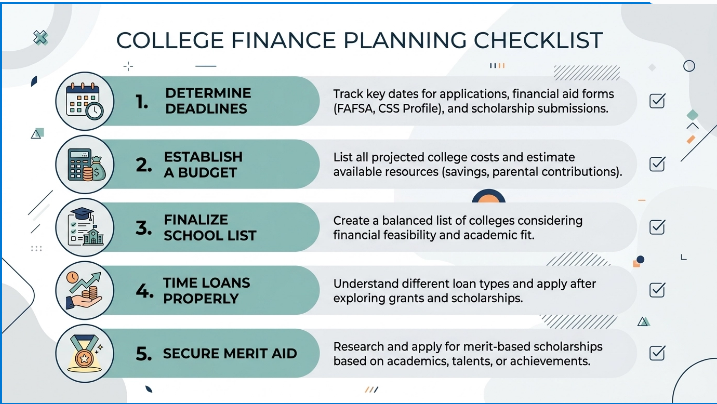
This news feels heavy, but I don't want you to panic. I want you to plan. As a former principal, I know that information is the best cure for anxiety. Here are five concrete actions you should take in the next 60 days.
1. If you already have Parent PLUS loans, act on consolidation now.
For parents with existing Parent PLUS loans, preserving access to income-driven repayment may depend on consolidating into a Direct Consolidation Loan and having that consolidation disbursed by June 30, 2026, not just submitted by then (Department of Education; NASFAA). In practical terms, the recommended application window has already passed. Borrowers who still need to consolidate to preserve income-driven repayment access should apply immediately, but should know that the Department of Education's consolidation processing typically takes up to three months, and any consolidation that does not disburse by June 30, 2026 will permanently lose access to income-driven plans.
2. Recalculate your "Net Price" expectations.
Don't look at the sticker price of the schools on your list. Look at the net price and subtract what you can actually afford plus the $20,000 federal cap. If the gap is still $30,000 per year, you need to find a way to cover that without federal parent loans.
To run this calculation automatically for any college on your list, try our free Affordability Estimator. No login required. Pick your income bracket or paste your federal SAI, and the tool shows your estimated net price plus your Parent PLUS gap under the new $20,000 cap, for any school in our database.
3. Audit your student's college list for "Financial Safeties."
In the old world, a safety was a school where your kid could get in. In the 2026 world, a safety is a school your kid can get into AND that you can afford under these new caps. You need at least two schools on the list where the total four-year gap is under $65,000.
4. Move your borrowing timeline up if you have a senior.
If your child is a senior, make sure your loan applications are processed and originated before July 1. This could be the difference between being grandfathered into the old system or being stuck with the new caps and losing a practical path to PSLF eligibility on new loans.
5. Research merit aid over brand names.
If you can't borrow the difference, you need the school to give you the difference. Focus on schools where your student's GPA and scores are in the top 25 percent. These schools are much more likely to offer merit scholarships that reduce the need for loans in the first place.
Why My School List is your financial co-pilot
When we started My School List, we did it because the college planning system was broken. It shouldn't cost $15,000 to get good advice. And it shouldn't take a law degree to figure out if you can afford to send your kid to their dream school.
We are currently building out even deeper affordability tools to help you navigate these new Parent PLUS caps. Our platform already helps you see your real admission odds for over 1,000 schools. This is critical because the best way to avoid a loan trap is to get into a school that actually wants your student and will pay for them to be there.
Our mission is equal access to guidance. Whether you are a first-generation family or a seasoned parent who has done this three times before, the rules just changed for everyone. You don't have to navigate this alone.
We are here to help you build a list that is academically exciting and financially responsible. If you want to stay ahead of these policy changes and find schools that fit your new budget reality, join us.
Ready to take the stress out of college planning?
Don't wait until the July 1st hammer drops to figure out your budget. Start building a smarter, safer college list today.
Sign up for a free trial of My School List here.
Get personalized odds, merit aid estimates, and the peace of mind that comes with a real plan. We just launched our free Affordability Estimator, built specifically for the OBBBA changes. Estimate your real cost at any school under the new $20,000 Parent PLUS cap before you sign up for the full platform.
Disclaimer: Financial aid policies, federal loan limits, and interest rates are subject to change by the Department of Education and legislative action. Always verify the latest terms at studentaid.gov.
Ready to build your college list?
Take our free College Fit Quiz at getmyschoollist.com/quiz
Take the Free Quiz →